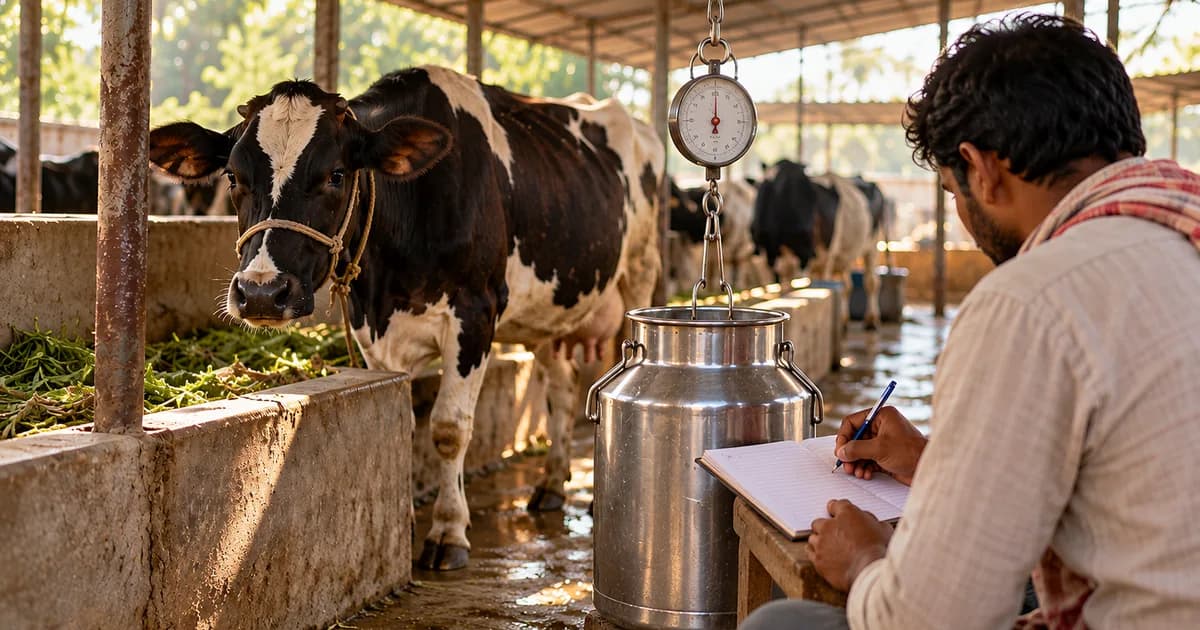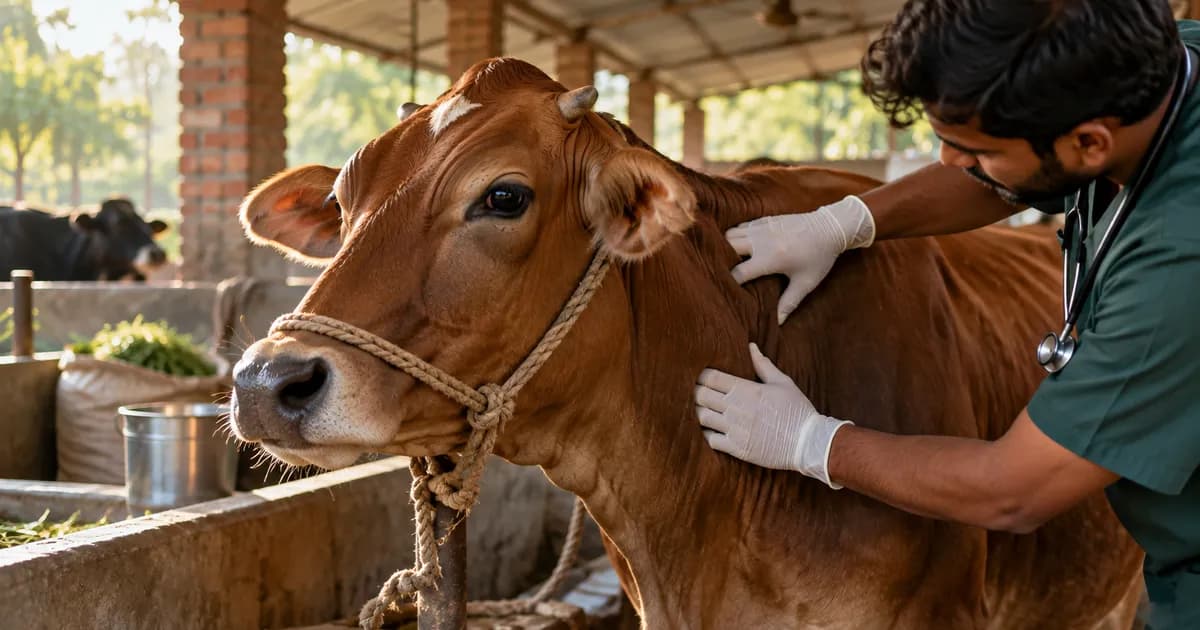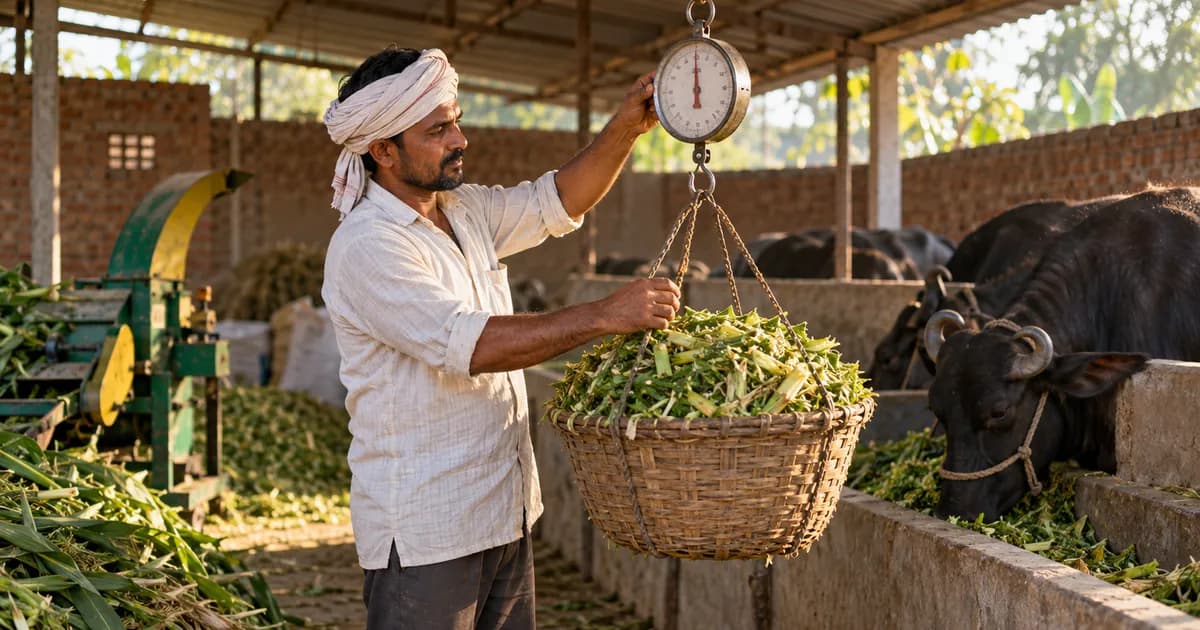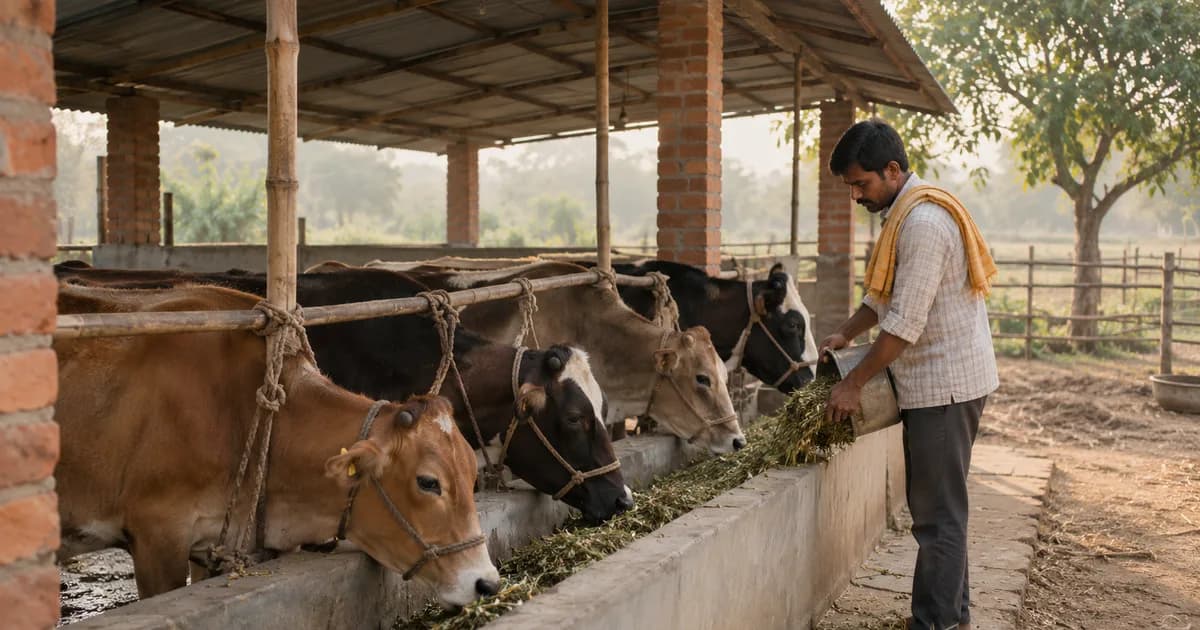
A low-budget dairy starts small: two to five animals, an open-sided shed with a roof that does not leak, and a cemented manger and gutter. Each crossbred cow needs a standing space of about 1.6 m × 1.1 m under cover, plus about 7 m² of open yard. Spend on the roof, the drainage and the floor slope; save on the walls.
- Plan about 3.5 m² of covered space and 7 m² of open yard per cow (4 m² and 8 m² per buffalo).
- A row of 5 cows needs a shed of about 5.5 m × 4.3 m, including the passage behind them.
- Besides the cow shed, you need a calving pen, calf pens, an isolation spot and a feed and milk store.
- Build in stages. Stage 1 is only the cow shed and the water.
- Check whether a subsidy is open before you count on it. The main dairy subsidy scheme is listed as closed on NABARD's site.
How many animals should a beginner start with?
Start with a number you can feed all year from your own fodder or a sure supply. Two to five animals is enough to learn milking, feeding, heat detection and the dairy's pricing before you borrow more. You can add stalls to the same shed later.
Pick one of two housing styles. Vikaspedia's housing pages describe both:
| Tied row in an open-sided shed | Loose housing (open yard with a shade shelter) | |
|---|---|---|
| Build cost | Higher: standing, gutter and partitions for every cow | Lower: a shelter on one side and a fenced yard |
| Land | Less | More floor space needed |
| Feeding | Each cow gets her own feed | Cows compete for feed |
| Milking | In the shed | Needs a separate milking spot |
| Weak point | Harder to expand; not suited to hot, humid areas | Not suited to heavy-rainfall areas |
For five cows or fewer, a tied row is simpler to run and to record, so the rest of this post uses it. If you have spare land and low rainfall, loose housing is the cheaper build.
Where should you build the shed?
- High, well-drained ground. The site should sit above the surrounding land so rain runs off. Avoid hollows.
- Water and shade. Keep clean water close. Trees at a short distance give shade and break the wind.
- Easy access for feed in and milk out, and for a vehicle to reach the shed.
- An existing wall. FAO suggests building against a wall you already have. A single-slope roof on one side is the cheapest way to cover the row.
- Direction. Vikaspedia's housing page says to run the long side of the barn north to south for sun on the floor. Some other guides say east to west in hot regions. Ask your local animal husbandry officer which is right for your area.
How big should the shed be?
These sizes come from FAO's small-scale dairy manual and Vikaspedia (NABARD and TANUVAS material). They are for a crossbred cow; a buffalo needs a standing of about 2.25 m × 1.35 m.
| Part | Size | Why |
|---|---|---|
| Standing, per cow | 1.60 m long × 1.10 m wide | Room to lie down and get up; dung falls in the gutter |
| Floor slope | 1 in 30 for rammed earth and gravel; 1 in 60 for concrete | Urine and water run away from the cow |
| Manger | 60 to 75 cm wide | A high front wastes less feed; a low front is easier on the cow |
| Head rail | 90 cm above the floor | Keeps the cow out of the feed |
| Partitions | 1.10 m apart, about 1 m long | Stops cows trampling each other's udders. No barbed wire, no sharp nails |
| Gutter | 40 cm wide, 15 cm deep, fall of 1 in 40, cement-finished | Carries dung and urine to a pit |
| Urine pit | 60 × 60 × 40 cm | Collects the flow |
| Passage behind the cows | About 1.5 m | Room for cleaning, milking and AI |
| Eaves height | Up to 2.4 m | Taller lets rain in and wind lift the roof |
| Roof overhang | 60 cm past the floor | Keeps rain off the standing |
| Water | A 60 × 50 × 20 cm tank for two cows, or buckets at least 3 times a day | Water all day is better |
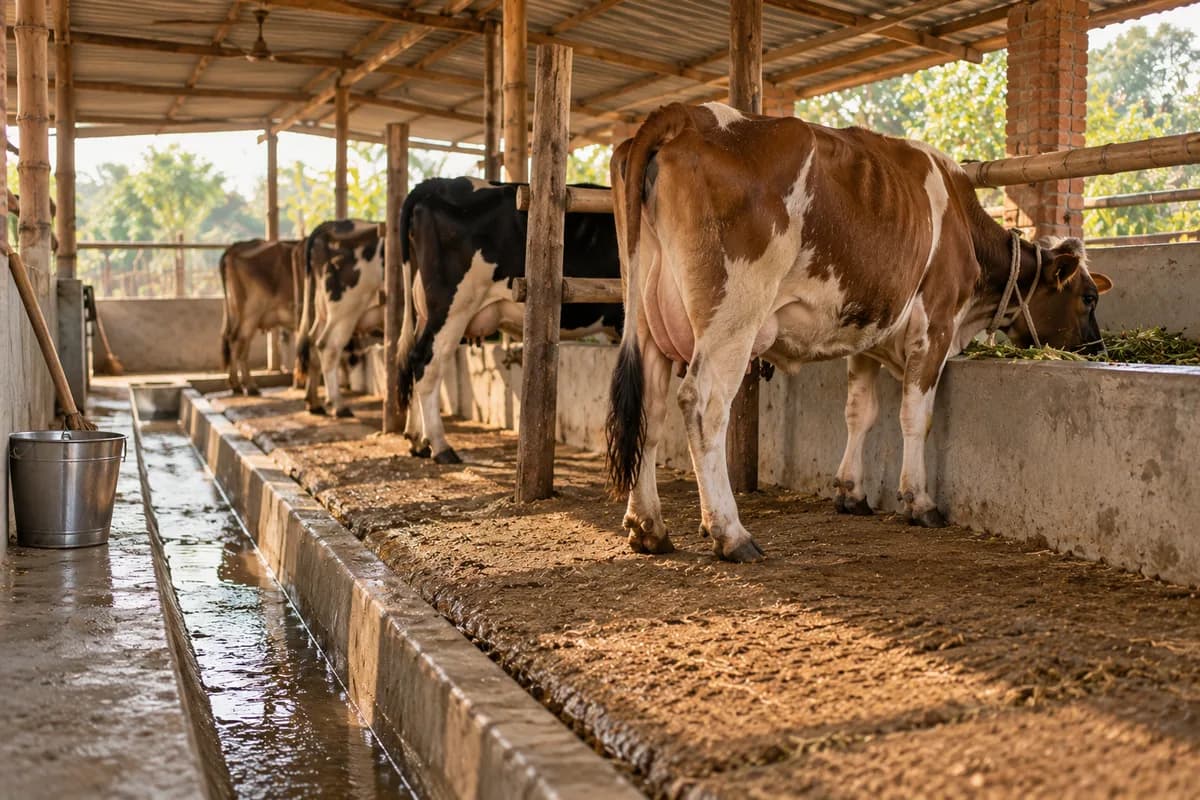
Add up the cross-section: manger 0.75 m + standing 1.6 m + gutter 0.4 m + passage 1.5 m is about 4.3 m wide. Five standings at 1.1 m each make the row 5.5 m long. That is about 23 m² under the roof, above the 17.5 m² you would get from the 3.5 m² norm.
Keep the sides open. FAO says open sides suit most places. Use curtains of bamboo strips, straw or palm mats against cold wind and driving rain, and half walls only if curtains are not enough. A cow also needs at least 800 cubic feet of air space in the tropics, which is why a high roof and a ridge opening matter more than walls.
What other areas does a small dairy need?
Here is a layout for 5 crossbred cows and up to 2 calves. Sizes come from the same sources.
| Area | Size | Notes |
|---|---|---|
| Cow shed (covered) | About 5.5 m × 4.3 m (23 m²) | Milking and dry cows can share a shed on a small farm |
| Open yard | 7 m² per cow, so about 35 m² | Fenced, with a few shade trees |
| Calving pen | 3 m × 4 m (12 m²) | Move a cow in 2 to 3 weeks before calving. Do not let her calve in the milking shed |
| Calf pens | 1.8 m × 1.0 m each | Calves stay until about 3 months. Never house calves with adults |
| Isolation box | About 14 m² (150 sq ft) | Away from the other animals, with its own drain |
| Quarantine spot | At the farm entrance | Keep new animals here for at least 30 to 40 days |
| Feed and milk store | Vikaspedia gives 3.75 m × 3 m for under 100 litres a day | Closed on all sides and rat-proof. Start with a corner if money is short |
| Straw or hay store | Adults eat 5 to 10 kg a day, so 25 to 50 kg a day for five | Work out the year's need before you size it |
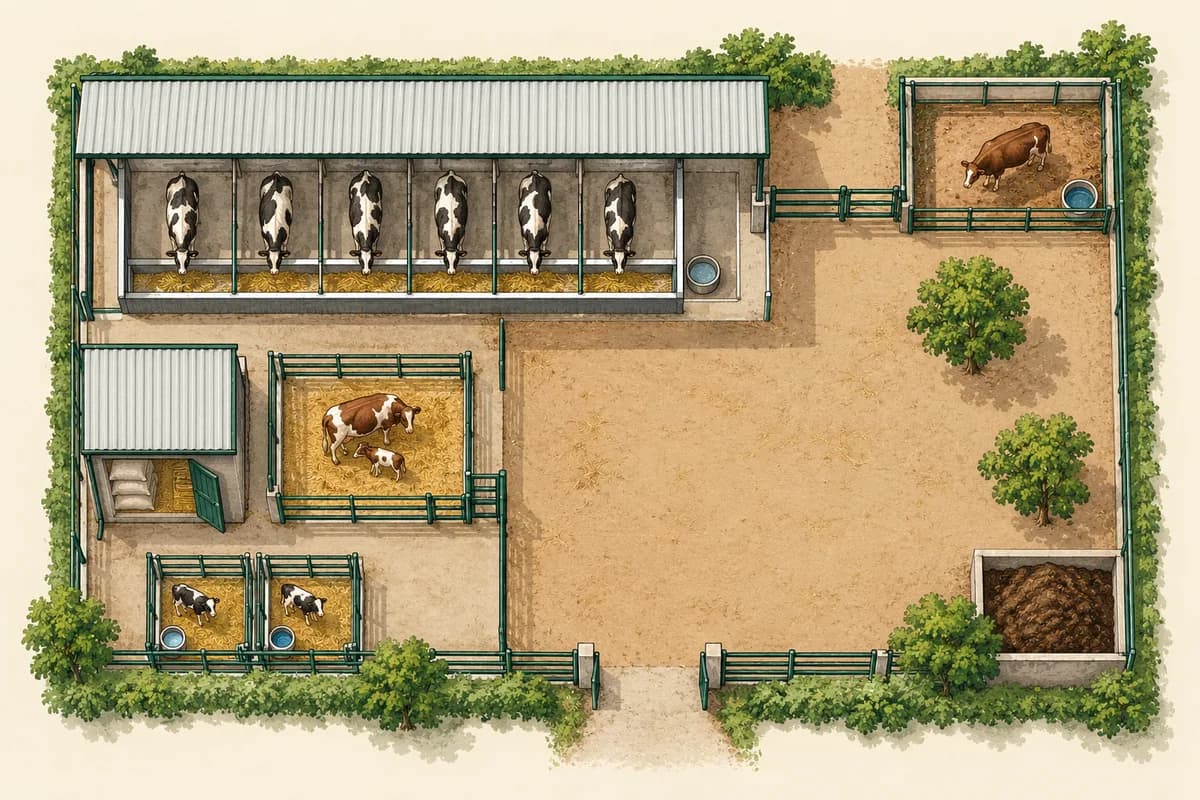
Adding the shed, yard and pens gives about 100 m². Leave about the same again for walking space, a manure pit and room to grow. A plot of about 150 m² (roughly 12 m × 12 m, or 1,600 sq ft) holds the buildings and yard. Fodder land is extra.
You do not need a bull. Vikaspedia says that where AI service is available, you can skip keeping a bull on the farm.
Where can you save money, and where not?
Save on things that only need to be there. Do not save on the things that keep cows dry, clean and uninjured.
- Save on walls. Open sides, dwarf walls of about 1.2 to 1.5 m, and a katcha or semi-katcha boundary wall around the yard all work, as long as the manger and trough are cemented.
- Save on the standing floor. Rammed earth and gravel costs least, if you keep it even and sloped. It needs regular repair.
- Save on partitions and posts. Local wood, bamboo or galvanised pipe do the job. Set wood or pipe posts in concrete to 30 cm above the ground so they last longer.
- Save on roofing at first. Thatch or straw is cheapest to put up, but FAO says to expect to replace it every 1 to 3 years, so tiles or sheets cost less over time.
- Cool a tin roof cheaply. A layer of straw or leaves over a metal roof, or a raised ridge for hot air to leave, keeps the heat down.
- Catch rain. A gutter on the roof and a tank give cheap, clean water.
- Do not save on the roof, the gutter or the slope. A leaking roof, pooled urine and a slippery floor cost more in injuries and lost milk than they save.
Never use barbed wire in a pen or partition, and never leave nails or sharp edges sticking out. They injure udders, which leads to mastitis.
Build it in three stages
FAO describes a modular plan for small farmers: build the shed first, then add the rest as milk income allows.
- Stage 1: the living area. The cow shed with standings, manger, gutter and roof, plus water.
- Stage 2: calves and exercise. A calving pen, calf pens, a fodder store, and the open yard with a manger.
- Stage 3: the clean milk side. A closed concentrate store, a place for equipment and water storage, and a rack or room for milk utensils.
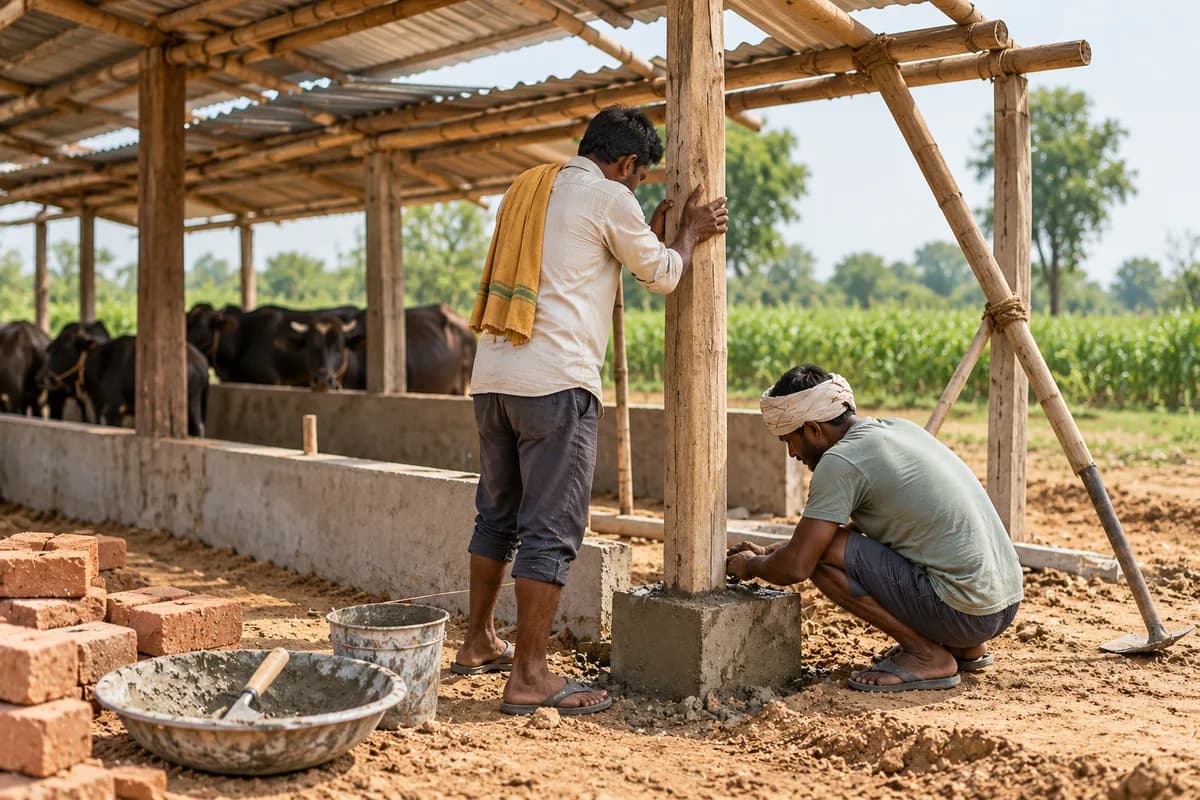
If you cannot afford a closed milk room, FAO says a rack on a wall or milk cans hung on a post, away from the standings and gutter, keeps utensils clean enough.
How do you pay for it?
Cost depends on your area, your materials and your labour, so get two or three local quotes. One vendor guide from 2026 puts a pucca shed at about ₹13,000 to ₹18,000 per animal and a local-material shed at about ₹8,000 to ₹10,000 per animal. For five cows that is roughly ₹40,000 to ₹90,000. This is a private estimate, not a government figure. Use it only as a rough check on a quote.
On credit, the Kisan Credit Card has covered working capital for animal husbandry and dairying since 2019, according to the Press Information Bureau. That is money for running costs such as feed. Ask your bank what is covered and the current limit.
As of 11 October 2026, NABARD's scheme page lists the Dairy Entrepreneurship Development Scheme (DEDS) as closed or temporarily closed. Do not plan around its subsidy. Ask your district animal husbandry office which schemes are open in your state.
What to do this week
- Decide how many animals you can feed all year, and whether they are cows or buffaloes.
- Walk the plot after rain. Choose the highest, best-drained spot with water and shade nearby.
- Draw the shed on paper using the sizes above, then count the posts, roof area and cement you need.
- Get two or three quotes for the roof, floor and cement work.
- Visit your district animal husbandry office or bank and ask which schemes and loans are open.
Once the animals arrive, a small dairy depends on its numbers. Pashupaalak keeps each animal's milk, feed, vaccines and costs in one place, so you can see your cost per litre from the first month. It is a web app now, and the Android app is coming soon. You can try it free on the web app, and work out your margin with the dairy farm profit calculator. Our post on the cost of milk production per litre shows how to count feed.